Claude Opus 4.7 Released
 Robert Prüst
Bit of a departure from the usual PowerShell and Azure content — Anthropic just released Claude Opus 4.7, and while this isn’t directly PowerShell-related, AI is changing how a lot of us work. It’s something I plan to dive into more on this blog going forward.
What’s New
Opus 4.7 is the latest flagship model from Anthropic, and the highlights from the announcement are worth a quick look:
- Better software engineering — notable improvements on difficult, long-running engineering tasks, with the model verifying its own outputs before reporting results
- Stronger instruction-following — substantially improved accuracy when following complex instructions
- Enhanced vision — image resolution support up to 2,576 pixels on the long edge (~3.75 megapixels), over 3x previous models. Better understanding of technical diagrams and chemical structures
- Improved memory — file-system-based memory across multi-session work
- New reasoning level — an extra-high effort level (
xhigh) for finer control over reasoning/latency tradeoffs - Task budgets (public beta) to guide how much token spend a task is allowed
/ultrareviewslash command in Claude Code for dedicated code review sessions
Luckily for us users, pricing stays the same as 4.6 — $5 per million input tokens, $25 per million output tokens. The model is available via the Claude API as claude-opus-4-7, and through Amazon Bedrock, Google Vertex AI, and Microsoft Foundry.
You can also see the latest model pop up in tools like GitHub Copilot, however this comes at a rather steep 7.5x token rate: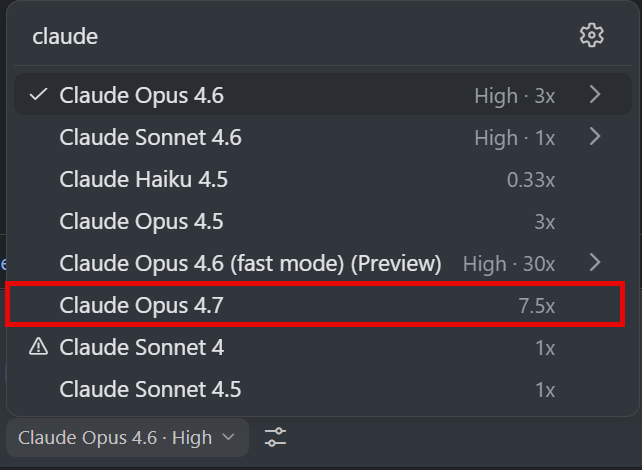
For Security Professionals
Another thing worth calling out — Anthropic has launched a Cyber Verification Program for security professionals who want to use Opus 4.7 for legitimate purposes like vulnerability research, penetration testing, and red-teaming. The model has automatic safeguards that detect and block high-risk cybersecurity requests, so if that’s your field of work, the verification program is the way to get proper access.
This does come at some demands, for instance enforcing MFA via SSO amongst others.
Check the program for more details!
Where I’m Going With This
AI is becoming a bigger part of how we build, debug, and ship code — and pretending it isn’t happening feels shortsighted. So expect more posts down the line where I share what I’m learning, what works, what doesn’t, and how it fits (or doesn’t fit) alongside the PowerShell, DevOps and Azure work I try and do on a daily basis.
For now — if you’re already using Claude, the upgraded model is worth it. If you haven’t tried it, this is a good moment to start.
Happy scripting 😊